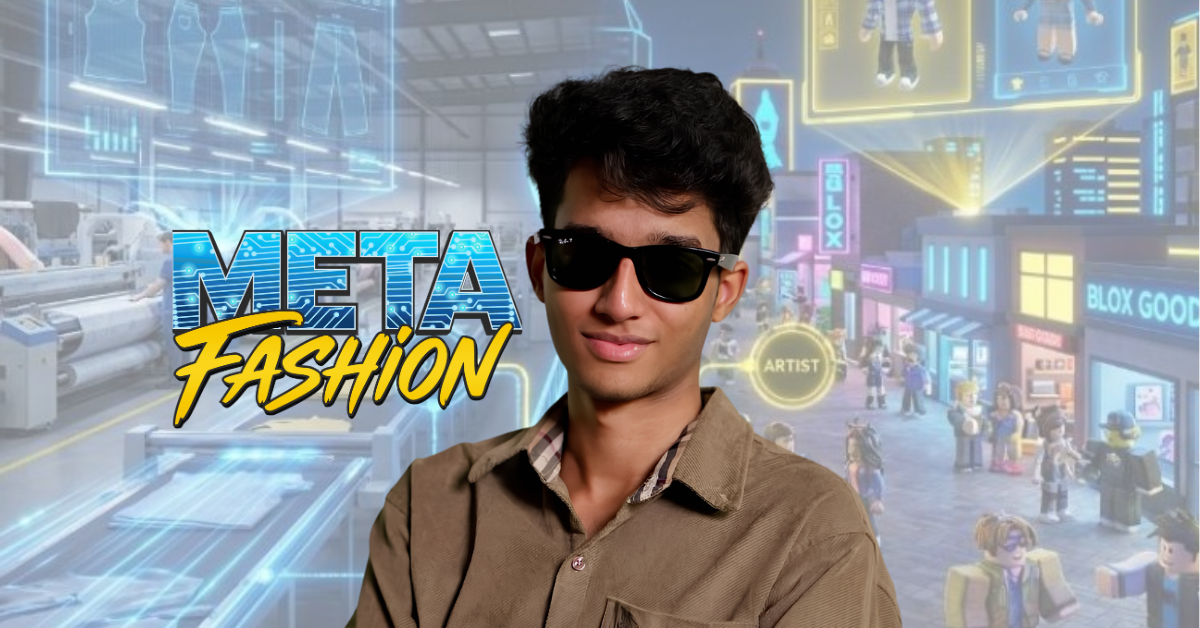
Meta Fashion has raised approximately $400,000 in a pre-seed funding round led by Lumikai as the startup looks to expand its virtual fashion ecosystem across gaming and user-generated content (UGC) platforms.
The funding round also saw participation from several angel investors including Big Bets, the family office of Anton Gauffin, along with investors Akshat Rathee and Pratham Mittal.
The company said the fresh capital will be used to scale its virtual fashion business, expand its original intellectual property game GlamGirls and strengthen its presence across multiple metaverse and gaming platforms.
Betting Big On Digital Fashion Economy
Founded in 2022 by Arjun Goel, Meta Fashion operates at the intersection of gaming, creator economies, artificial intelligence and digital commerce.
The startup creates trend-driven virtual fashion assets for platforms including Roblox, Fortnite and ZEPETO.
In addition to digital wearables, the company also runs a “phygital” direct-to-consumer model that converts successful virtual fashion products into physical merchandise for real-world consumers.
Industry analysts say the line between gaming, fashion and digital identity is increasingly blurring as younger consumers spend more time in virtual environments.
AI-Native Fast Fashion Engine
Meta Fashion describes its platform as an AI-native “fast fashion” engine built specifically for digital assets.
According to the company, its AI-powered styling and creation systems analyse live marketplace demand signals and user behaviour trends to accelerate fashion asset production and improve discovery across virtual platforms.
The startup believes this allows it to rapidly respond to changing consumer preferences within gaming ecosystems much like traditional fast-fashion companies operate in physical retail.
Industry experts say AI-generated content and virtual asset creation could become major growth areas as gaming economies continue to evolve globally.
Strong Early Traction On Roblox
Meta Fashion claims it has already sold more than 2.5 million virtual fashion units through the Roblox marketplace.
According to the company, those sales generated nearly $300,000 in gross merchandise value (GMV) while operating at an exceptionally high gross margin of around 92 per cent.
The startup has also collaborated with global brands including Walmart to bring real-world products into virtual gaming environments.
Analysts say major brands are increasingly experimenting with metaverse and gaming integrations to connect with younger digital-first audiences.
GlamGirls Emerging As Key Growth Driver
The company’s original gaming property, GlamGirls, has also shown early traction.
Launched in beta on Roblox in late 2025, the dress-up and fashion-focused game has reportedly attracted more than 100,000 paying users.
According to the company:
- 75% of users are female
- Nearly 50% are above the age of 18
Industry experts believe the strong female user base could position Meta Fashion uniquely within gaming ecosystems that have historically been male-dominated.
The rise of social gaming, avatar-based identities and virtual self-expression has opened up new opportunities in digital fashion and creator-driven commerce.
Gaming And Fashion Ecosystems Converging
The funding reflects a broader global trend where gaming platforms are increasingly becoming commerce and identity ecosystems rather than just entertainment products.
Virtual skins, digital collectibles, avatar accessories and creator economies are now generating billions of dollars globally.
Analysts believe Gen Z and younger consumers increasingly view digital identities and virtual appearance as extensions of real-world self-expression.
This has created a rapidly growing market for virtual fashion, AI-generated design and metaverse native brands.
Competition Intensifying In Digital Fashion Space
Meta Fashion operates in an increasingly competitive digital fashion and gaming commerce ecosystem.
The startup may compete directly or indirectly with companies such as Twin Atlas, TOPCAT, Reverse Polarity and PhygitalTwin.
However, investors appear optimistic about the long-term potential of gaming-native fashion ecosystems.
Industry observers say the convergence of AI, gaming, digital ownership and creator economies could create entirely new consumer categories over the next decade.
As gaming platforms continue evolving into large scale digital social spaces, companies like Meta Fashion are attempting to position themselves at the centre of the emerging virtual fashion economy.