Can Skyroot Become India’s First Commercial Space Launch Success Story?
Indian spacetech unicorn Skyroot Aerospace has crossed a major milestone, reporting over Rs 100 crore in revenue for FY26 even before launching its first commercial rocket.
According to provisional financial statements reviewed by Entrackr, the Hyderabad-based company recorded operating revenue of Rs 100.6 crore during FY26, marking its first meaningful revenue generation since inception. The achievement comes shortly after Skyroot entered the unicorn club following a $60 million funding round that valued the startup at approximately $1.1 billion.
The performance is particularly noteworthy because Skyroot has yet to begin commercial satellite launch operations, traditionally considered the primary revenue stream for rocket companies.
Where Is Skyroot’s Revenue Coming From?
Unlike most space startups that remain dependent on funding until launch operations begin, Skyroot has started monetizing its Space Systems business.
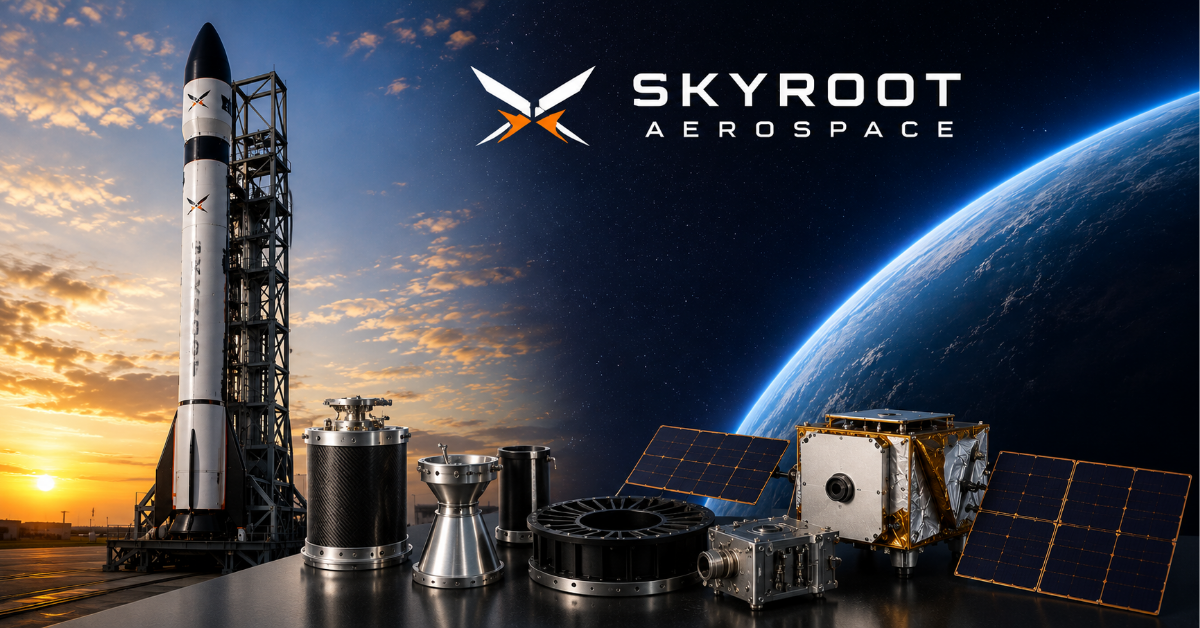
The company manufactures critical aerospace and satellite components, including composite satellite structures, payload adaptors, propulsion systems, actuators, nozzles, composite motor cases, and other launch vehicle hardware.
These products are supplied to customers operating in the broader space ecosystem, allowing Skyroot to generate revenue while continuing development of its launch vehicles.
As recently as FY25, the company remained pre-revenue and did not report any operating income, highlighting the pace of its commercial progress over the past year.
Why Are Losses Still Increasing?
Despite crossing the Rs 100 crore revenue milestone, Skyroot remains in an investment-heavy growth phase.
The company reported a negative EBITDA of Rs 130.3 crore during FY26, compared to a negative EBITDA of Rs 107.7 crore in FY25.
A significant portion of the expenditure was directed towards hiring, research and development, testing infrastructure, and operational expansion. Employee benefit expenses surged to Rs 95.5 crore during FY26 from Rs 35.9 crore a year earlier, while operating and administrative costs rose to Rs 88.2 crore.
Industry experts note that such investments are typical for rocket companies, which require extensive testing, engineering talent, and infrastructure before generating meaningful launch revenues.
How Important Is The Vikram-I Launch?
The company’s next major milestone is the maiden launch of its Vikram-I rocket, expected during the ongoing fiscal year.
Skyroot projects revenue to increase nearly tenfold to Rs 977 crore in FY27. Of this, Rs 345 crore is expected to come from launch services, while Rs 633 crore is projected from the Space Systems business.
The successful commercial deployment of Vikram-I would transform Skyroot from a component supplier into a full-scale launch services provider, opening a much larger revenue opportunity.
Can Skyroot Reach Rs 13,205 Crore Revenue By FY32?
According to the company’s long-term projections, revenue could grow from Rs 101 crore in FY26 to Rs 13,205 crore by FY32.
The growth is expected to be driven by commercial operations of Vikram-I, the future Vikram-II rocket, and the company’s reusable launch vehicle (RLV) program.
The projections also indicate strong customer demand. As of March 2026, Skyroot had customer advances exceeding Rs 252 crore and expects to execute more than Rs 605 crore worth of Space Systems orders by FY28.
What Does This Mean For India’s Private Space Sector?
Skyroot’s financial progress highlights the rapid evolution of India’s private space ecosystem following regulatory reforms and increased private-sector participation.
While Indian spacetech startups have historically relied heavily on venture funding, Skyroot’s ability to generate commercial revenue before launching its first rocket demonstrates a potentially sustainable business model.
If the company successfully executes its launch roadmap, it could emerge as one of India’s most significant deeptech success stories and strengthen the country’s position in the global commercial space market.