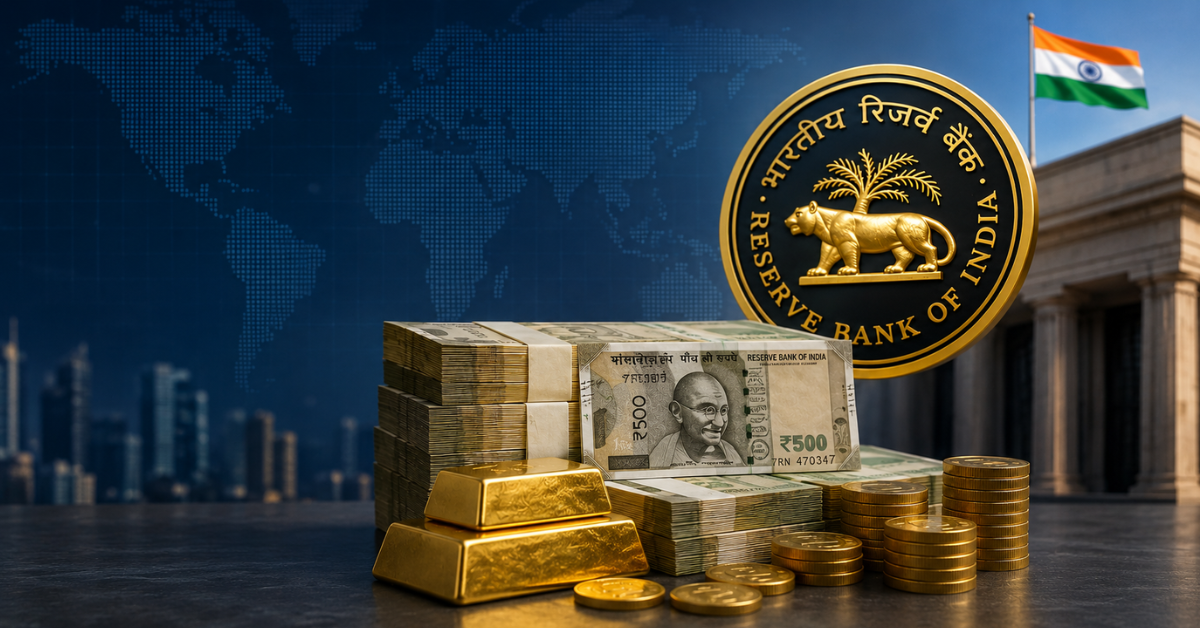
Reserve Bank of India said India’s foreign exchange reserves declined by $8.094 billion to $688.894 billion during the week ended May 15.
The latest decline comes after the country’s forex reserves had increased by $6.295 billion to $696.988 billion in the previous reporting week ended May 8.
According to RBI data released on Friday, the fall in reserves was primarily driven by a sharp decline in foreign currency assets and gold reserves.
Foreign Currency Assets Decline
Foreign currency assets (FCAs), which form the largest component of India’s forex reserves, declined by $6.483 billion to $545.904 billion during the reporting week.
FCAs include the impact of appreciation or depreciation in non-US currencies such as the euro, pound and yen held in the reserves.
Analysts said fluctuations in global currency markets and RBI intervention in the foreign exchange market may have contributed to the decline.
Gold Reserves Also Fall
India’s gold reserves also witnessed a decline during the week.
According to RBI data, the value of gold reserves dropped by $1.536 billion to $119.317 billion.
Gold has increasingly become an important component of India’s reserve diversification strategy over the last few years.
SDRs And IMF Position Edge Lower
The country’s Special Drawing Rights (SDRs) with the International Monetary Fund declined by $49 million to $18.824 billion.
India’s reserve position with the IMF also slipped by $25 million to $4.85 billion during the week.
Reserves Had Earlier Hit Record High
India’s forex reserves had touched an all-time high of $728.494 billion during the week ended February 27 earlier this year.
However, reserves have since witnessed volatility following geopolitical tensions in West Asia and pressure on the Indian rupee.
Industry experts say the RBI has actively intervened in the currency market through dollar sales to stabilise the rupee amid global uncertainty and rising crude oil prices.
Geopolitical Tensions Impacting Rupee
The ongoing West Asia conflict has intensified pressure on emerging-market currencies, including the Indian rupee.
Higher oil prices increase India’s import bill because the country imports a large share of its crude oil requirements.
This, in turn, raises demand for dollars and puts pressure on India’s external balances.
Analysts believe the RBI may continue to use forex reserves strategically to smooth excessive volatility in the currency market.
PM Modi Calls For Forex Conservation
Prime Minister Narendra Modi has also made multiple public appeals urging citizens to help conserve foreign exchange reserves.
Beginning May 11, Modi urged people to reduce unnecessary foreign travel, limit fuel consumption and avoid gold purchases for a year to support the country’s economic stability amid global uncertainty.
India Still Holds Strong Reserve Buffer
Despite the latest decline, economists note that India’s forex reserves remain among the world’s largest and continue to provide a strong external stability buffer.
India’s reserve position is considered sufficient to cover several months of imports and support currency stability during periods of market stress.
Analysts believe the trajectory of reserves in the coming months will largely depend on global crude oil prices, foreign capital flows, currency movements and the intensity of geopolitical tensions affecting global financial markets.