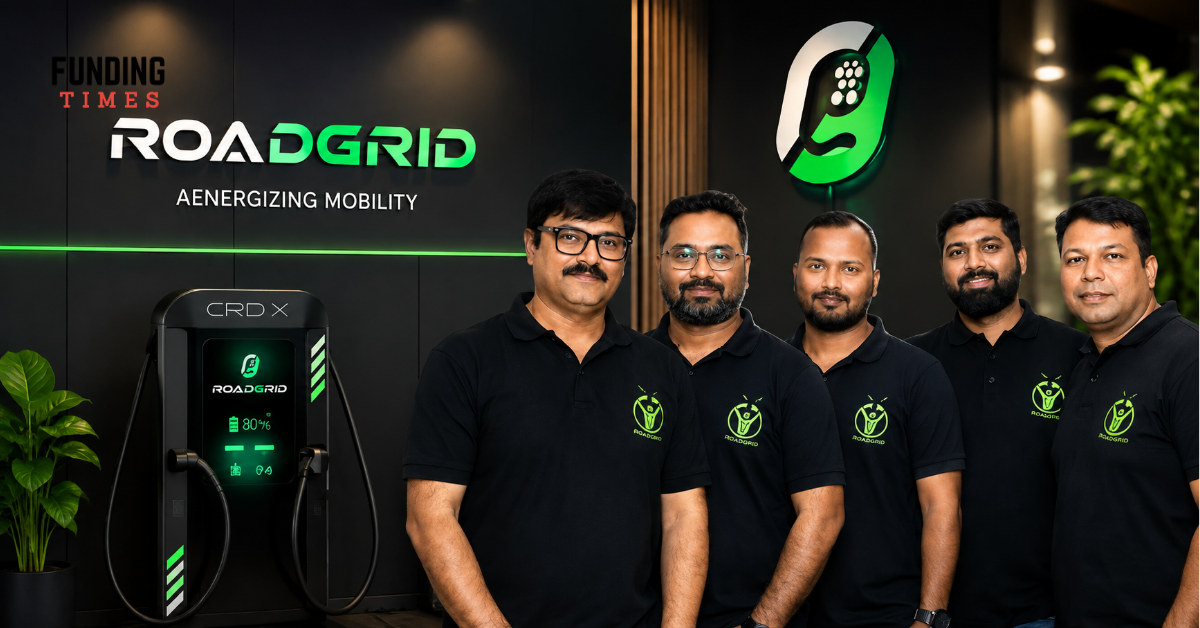
EV charging technology startup RoadGrid has secured ₹13 crore in financial assistance from the Technology Development Board (TDB) under the Department of Science and Technology (DST) to support a ₹27.5 crore manufacturing project. The funding will help the company establish a dedicated manufacturing and assembly facility for its patented Universal EV Charger, strengthening India’s domestic EV charging infrastructure.
The latest support comes just months after RoadGrid raised ₹12 crore in a pre-Series A funding round led by Venture Catalysts, underscoring growing investor and government confidence in the startup’s technology.
Funding to Build Dedicated EV Charger Manufacturing Facility
RoadGrid will use the financial assistance to set up a new manufacturing and assembly facility for its Universal EV Charger, which is designed to support multiple categories of electric vehicles through a single platform.
According to the company, the facility will have an annual production capacity of 2,000 chargers, with commercial production expected to commence in March 2027.
The project is aimed at strengthening domestic manufacturing capabilities while supporting India’s rapidly expanding electric mobility ecosystem.
Universal EV Charger Supports Multiple Vehicle Segments
Founded in 2020, RoadGrid develops EV charging hardware, software, and energy management solutions.
Its flagship Universal EV Charger is compatible with electric two-wheelers, three-wheelers, passenger vehicles, and commercial electric vehicles, enabling charging infrastructure providers to serve multiple vehicle categories using a single charging platform.
By offering interoperable charging solutions, the company aims to simplify EV infrastructure deployment and improve accessibility for fleet operators, businesses, and consumers.
Facility to Manufacture Critical EV Charging Components
The upcoming manufacturing unit will produce and assemble several key components required for EV charging systems.
According to RoadGrid, the facility will manufacture power electronics, thermal management systems, communication modules, control hardware, and metering systems, with a strong focus on using locally manufactured components.
The project is also expected to generate more than 100 direct jobs, contributing to India’s manufacturing ecosystem while supporting the government’s Make in India initiative.
Growing Enterprise Customer Base
RoadGrid currently employs more than 40 professionals and has already deployed over 100 EV chargers, managing more than 200 charging points across its network.
The startup serves six enterprise customers and has established partnerships with major organizations, including VinFast, HPCL, and IOCL, reflecting increasing adoption of its charging technology across the EV ecosystem.
Its integrated offering combines charging hardware, software, and energy management solutions to support businesses deploying EV infrastructure at scale.
Government Support Builds on Recent Funding Momentum
Earlier this year, RoadGrid secured ₹12 crore in a pre-Series A funding round led by Venture Catalysts, with the capital earmarked for product development, manufacturing expansion, and charging infrastructure deployment.
The additional support from the Technology Development Board further strengthens the company’s growth plans while highlighting the government’s commitment to promoting indigenous EV technologies.
RoadGrid expects the new manufacturing facility to generate around ₹100 crore in annual revenue at an initial production level of 1,000 chargers, creating a strong foundation for future expansion.
Strengthening India’s EV Infrastructure Ecosystem
As electric vehicle adoption accelerates across India, demand for reliable and domestically manufactured charging infrastructure continues to grow.
With government backing, a scalable manufacturing facility, strategic enterprise partnerships, and proprietary charging technology, RoadGrid is well positioned to contribute to India’s transition toward sustainable mobility.
The new investment is expected to help the company expand production, strengthen domestic manufacturing capabilities, and support the country’s rapidly growing electric vehicle charging network.